


Surviving Academic Conferences: A Guide for the Overwhelmed
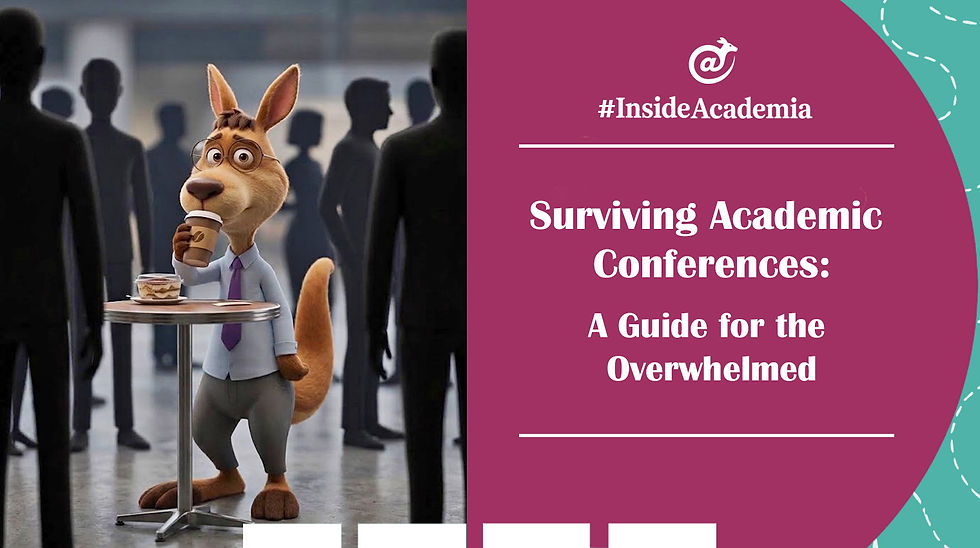
Conferences can be overwhelming, especially the big international ones. In recent years, I have mostly attended smaller or more specialised events. This summer, when I returned to a large-scale European conference, it did not take long to remember why.
It is very easy to underestimate what a crowd of more than a thousand people feels like when everyone is in the same place at the same time. It becomes even more intimidating when you remember that many of them are in the same field, applying for similar vacancies, publishing in similar journals, and recognising each other much more easily than you recognise them.
Then there is the social geography of conferences: many participants arrive in groups from the same university, country, doctoral network, or research cluster; people who appear to know where they are going for dinner before you have even found the coffee. A good half of them will also continue speaking their native languages with peers during and between sessions. There were several sessions where I was probably the only non-German speaker in the room. I have rarely felt so international.
None of this is wrong. It just leaves you slightly outnumbered when your group consists of one.
I arrived alone from my university. No current or former co-authors in sight in the conference programme. I was also about to present a paper that I knew could rub parts of the room the wrong way: examples linked to the Russia-Ukraine conflict, gay and trans representation, and the kind of topic where one badly phrased sentence can make you wish you had chosen a safer hobby, like crocodile dentistry.
I have to say that getting opposition at a conference presentation is not the problem. In fact, it would be a dream come true. What most of us actually fear is presenting into silence. Sometimes that silence means the presentation was unclear. Sometimes it means the audience is tired, the room is small, the timing is unlucky, or the paper was actually so clear that nobody immediately knows what to ask (yes, as if!). Rationally, we know all this.
Emotionally, five seconds of silence after "Any questions?" can still feel like peer review with furniture.
So this time, I decided to do things differently.
First, I used Tatiana Andreeva's advice on preparing for conferences and contacted people I had been meaning to meet in person, whether I knew their work or had only connected with them online. Having a few conversations arranged in advance gave the conference some structure before it even started. It also reduced the pressure on every coffee break to become a decisive career moment, which is a very unfair burden to place on coffee.
Second, I tried to be useful in the sessions I attended. If I was in the room, I made sure not to let a presentation end with no questions. Sometimes the question was about framing. Sometimes it was about method. Sometimes it was simply the one thing that made me think, "Wait, but what happens if we look at it from this angle?" I also took notes for presenters in my own session and sent them afterwards through the conference app.
This was not a grand act of academic generosity. I was already there. I was already listening. Writing down a few useful thoughts and sharing them did not require heroic sacrifice. Still, the reaction surprised me. It was nice to hear words of appreciation from the moderators, and even nicer to see presenters positively puzzled, saying something like: "I had not thought about it like that before."
You can see people’s faces change when the first, and often the only, question arrives and the fear of silence lifts.
And, of course, these things come back to you. When my own presentation concluded, we did not have enough time to address all the questions directed to my paper. All of them were genuinely supportive. I cannot prove this, but I am fairly sure that some of that support came from people whose sessions I had attended and contributed to earlier. Academic karma may not be methodologically robust, but I am willing to keep testing it.
The social part was still harder.
Conferences can be brilliant, but they can also be socially exhausting when you are attending without an obvious home group. Everyone seems to be moving somewhere, meeting someone, recognising someone, saving a seat for someone. Meanwhile, you are trying to look purposeful while deciding whether it is too early for another coffee.
My natural instinct in those moments is simple: find a corner, hide in it, and ideally hide with food, so the whole thing can be reframed as "having lunch" rather than "avoiding humanity."
At this conference, the instinct appeared several times, and the catering team had helpfully provided an endless supply of tiramisu cups to support it. In crowded common spaces, surrounded by conversations in languages I did not understand, I had to fight the urge to disappear into a corner with yet another mini-dessert. I did not become a social butterfly. I did not suddenly develop conference extroversion. I just stayed around a little longer than I wanted to, usually holding a tiramisu as an alibi.
That was where some of the loveliest moments happened. A former colleague found me halfway through what was definitely not my first dessert of the day. Later, I ran into a former student from a previous role, now a PhD student in an adjacent field. Neither of these encounters were scheduled, optimised, or strategically engineered. They happened because I did not leave the room too quickly.
So, if large conferences overwhelm you as much as they still overwhelm me, even after 14 years of attending the big and the small, the local and the exotic, the tightly themed and the "why exactly am I here?" ones, here is a strategy that does not require becoming a completely different person for three days:
Prepare before the conference.
Be useful in the room.
Ask the question you would want someone to ask you.
Stay visible a little longer than feels natural.
Never underestimate the professional importance of tiramisu.


Comments